Quality assurance was an obvious early target for AI. The work involves checking large volumes against defined criteria, which sounds like exactly what automation should absorb. The results so far are genuinely mixed, and worth being precise about. AI has made parts of QA dramatically faster and has quietly made other parts worse, usually where teams assumed a capability that was not there. This guide separates the two.
A note on terminology, because these are frequently confused. This piece is about using AI to perform quality assurance work. The separate question of assuring the quality of AI systems is covered in ourAI quality assurance overview.
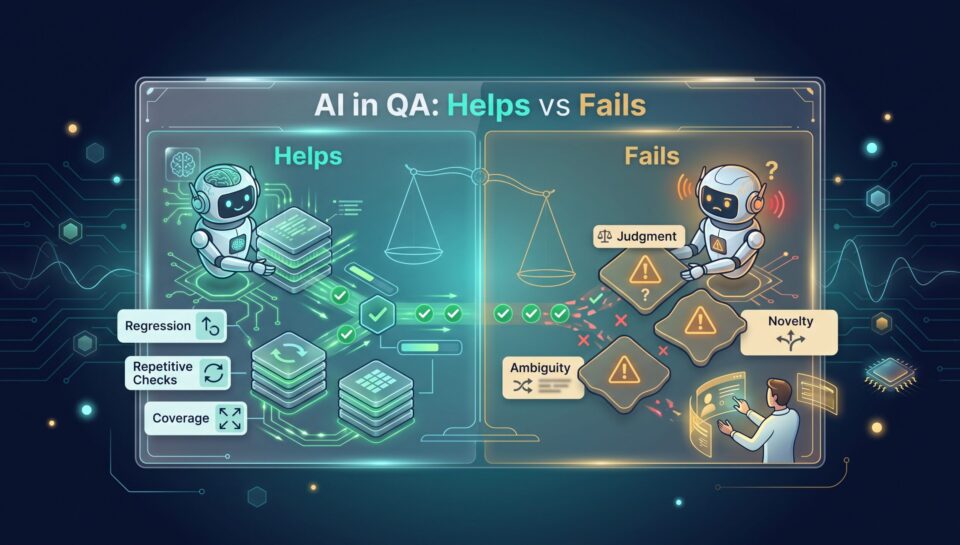
Where AI Genuinely Helps
Coverage at volume. The strongest case. AI can check every item where humans could only sample. For high-volume, rule-checkable work, this is a real change in kind rather than degree: you move from inferring quality from a sample to observing it across the population.
Pattern and anomaly detection. AI is good at noticing that something differs from the norm, which surfaces candidates for human attention. It is far better at "this looks unusual" than at "this is wrong," and used that way it is genuinely valuable as a triage layer.
Consistency on mechanical criteria. Where a rule is unambiguous, automated checking applies it identically every time, without the fatigue and drift that affect human reviewers late in a long queue.
First-pass filtering. Removing the clearly-fine and flagging the clearly-problematic, so human attention concentrates on the ambiguous middle where it adds the most value.
Drafting and documentation. Producing test cases, summarising defects, and drafting reports, where the output is reviewed anyway.
Where It Fails, and Why
Judgment against ambiguous criteria. Most real quality standards contain irreducible ambiguity. Is this tone appropriate? Is this technically-true claim misleading? Is this edge case acceptable in context? AI produces confident answers to these and the answers are unreliable, which is worse than no answer because it does not signal its own uncertainty.
Novel failure modes. AI checks against patterns it has seen. Genuinely new problems, which are often the important ones, tend to pass because they do not resemble known defects.
Understanding intent. Knowing whether something is wrong often requires knowing what it was supposed to achieve. AI checking output against criteria has no access to intent unless it is fully specified, and full specification is usually impossible.
Domain-specific correctness. In medical, legal, and financial work, correctness depends on knowledge and context that general-purpose AI applies unreliably, with high confidence.
The Failure Mode Nobody Plans For
The most damaging pattern is not AI making mistakes. It is AI making mistakes while creating the impression of thorough coverage.
When automated checking reports that ten thousand items passed, the natural inference is that quality is good. What it actually means is that ten thousand items did not trigger the checks that exist. If the checks miss a category of defect, the report is confidently wrong at scale, and the false assurance is more dangerous than the original gap because it stops anyone looking.
This is why automated QA needs its own verification: human review of a sample of items the automation passed, specifically to find what it missed. Teams routinely audit the items automation flags and almost never audit the items it cleared, which is exactly backwards for discovering blind spots.
A Structure That Works
The pattern that holds up in practice is layered rather than either-or.
Automation handles full-coverage mechanical checks and flags anomalies. Human review concentrates on the flagged items, the ambiguous middle, and the high-stakes categories where a miss is expensive. A sample of automation-passed items gets human review specifically to test the automation's blind spots. And findings feed back into both the automated rules and the human guidelines.
The human layer needs the same discipline it always did: clear criteria, trained reviewers, and measured agreement so the judgment is consistent rather than personal. Ourannotation quality guide covers the method, and ourquality assurance process overview covers the fundamentals.
The Question to Ask Before Automating a Check
One test cuts through most decisions: can this criterion be stated precisely enough that two careful people would apply it identically? If yes, it is a strong automation candidate. If no, automating it does not remove the ambiguity, it hides it behind a number, and the disagreement that would have surfaced in human review disappears into a score nobody questions.
What This Means for Buying Decisions
Vendors selling AI-powered quality assurance are usually offering real value on the mechanical layer and overstating the judgment layer. The useful questions are: which specific checks does this perform, what does it not check, how does it behave on ambiguous cases, and does it express uncertainty or always produce a verdict? A tool that always returns a confident answer on ambiguous input is a liability rather than an asset.
The Honest Summary
AI has meaningfully improved quality assurance where the work was mechanical, high-volume, and rule-checkable. It has not replaced judgment, and deployments that assumed it would have generally produced worse outcomes with better-looking reports. The teams getting real value are the ones that automated the checkable parts aggressively and kept people on the parts that require knowing what good means.
Common Questions From US Teams
Where does AI genuinely help quality assurance?
Full coverage on rule-checkable criteria, anomaly detection as a triage layer, consistent application of unambiguous rules, first-pass filtering, and drafting test cases and reports.
Where does AI fail in QA work?
Judgment against ambiguous criteria, novel failure modes it has not seen, understanding intent, and domain-specific correctness in fields like medicine, law, and finance.
What is the biggest risk in automating quality assurance?
False assurance. A report that ten thousand items passed means they did not trigger the existing checks, not that quality is good. If a defect category is unchecked, the report is confidently wrong at scale.
How do I find automation blind spots?
Human-review a sample of items the automation passed, not only the items it flagged. Most teams audit flagged items and never audit cleared ones, which is backwards for discovering gaps.
How should automated and human QA be combined?
Automation for full-coverage mechanical checks and anomaly flagging, humans for flagged items, ambiguous cases, and high-stakes categories, plus sampled review of passed items to test blind spots.
How do I decide whether to automate a specific check?
Ask whether the criterion can be stated precisely enough that two careful people would apply it identically. If not, automating it hides the ambiguity behind a number rather than resolving it.
What should I ask an AI QA vendor?
Which specific checks it performs, what it does not check, how it behaves on ambiguous input, and whether it expresses uncertainty or always returns a verdict. Always-confident tools on ambiguous input are a liability.
Has AI replaced human quality assurance?
No. It has absorbed the mechanical, high-volume, rule-checkable portion effectively. Judgment about what good means, in context, still requires people.
Working With Prudent Partners
Prudent Partners Private Limited provides the human judgment layer that automated quality checking cannot cover: review of flagged and ambiguous cases, sampled audit of automation-passed items to surface blind spots, and defect reporting by category, all with clear criteria and measured reviewer agreement. See ourAI quality assurance function andquality assurance process overview.
The first conversation is a 30-minute scoping call about your current QA process, what is automated, and where the gaps are. No commitment to go further.