Most annotation procurement focuses on two things: can the vendor do the work, and what does it cost. A third factor predicts outcomes better than either, and buyers rarely ask about it directly. That factor is the delivery model: how the work is staffed, how it is reviewed, and where it runs. Two providers quoting similar rates for similar capabilities can deliver very differently depending on these choices, and the differences compound over the life of an engagement. This guide covers the delivery decisions worth specifying before you sign.
Dedicated Teams Versus Rotating Pools
The most consequential staffing choice, and the one buyers increasingly search for specifically.
In a rotating pool model, work is distributed across whoever is available. It flexes well with volume and costs less to operate, and for simple, unambiguous tasks it can be entirely appropriate. Its weakness is that nobody accumulates familiarity with your data. Every batch is handled by people encountering your edge cases for the first time, so the same questions get asked and the same mistakes get made repeatedly.
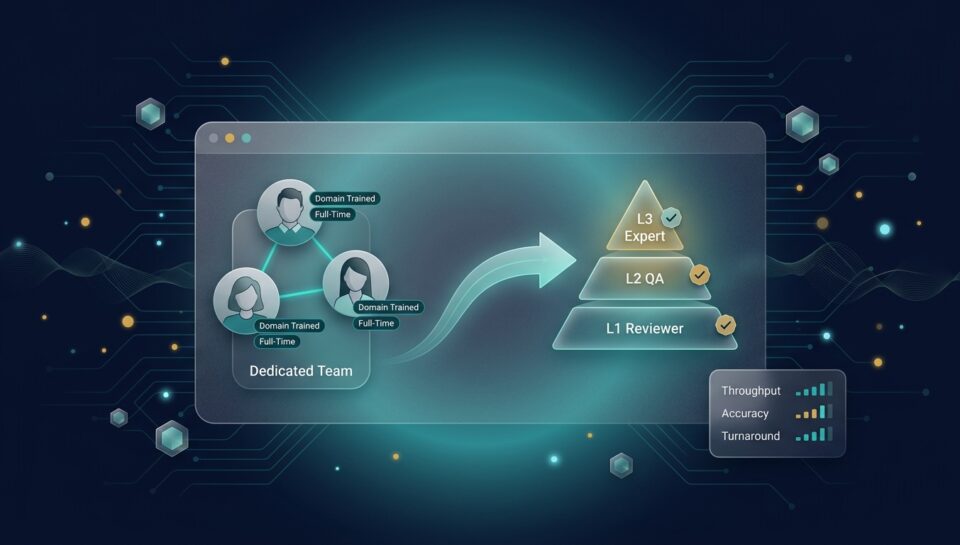
In a dedicated team model, a named group works only on your project. They learn your domain, your conventions, and the judgment calls your guidelines cannot fully specify. Quality typically improves over the first weeks and then holds, because the team has internalised what good looks like rather than reading it fresh each time.
The trade is cost and flexibility against consistency and learning. For simple high-volume work, rotating pools are defensible. For anything involving domain judgment, subtle distinctions, or evolving guidelines, a dedicated team usually produces better data at a lower total cost once rework is counted.
The practical question to ask: will the same people work on our project throughout, and what is your annotator retention on long-running engagements? High turnover inside a nominally dedicated team produces rotating-pool outcomes with dedicated-team pricing.
Multi-Stage Review
Single-pass annotation, where one person labels an item and it ships, is faster and cheaper and generates the quality problems that surface downstream.
A documented multi-stage process typically layers annotation, independent review, and escalation of disagreement to a senior reviewer or subject expert. What matters is not the number of stages but whether the stages are independent and whether disagreement is measured rather than silently resolved. Review that simply confirms the first annotator's work adds cost without adding quality; review that independently labels and then compares surfaces genuine problems.
Ask what proportion of items pass through each stage, since "multi-stage review" often means a small sample gets a second look. Ask how disagreement is resolved and whether disagreement rates are reported to you. Persistent disagreement usually indicates ambiguous guidelines rather than careless annotators, which is useful information you should be receiving. Our guide toannotation quality and inter-annotator agreement covers the measurement behind this.
Deployment Model
Where the work physically happens matters increasingly, particularly for regulated or commercially sensitive data.
Shared infrastructure is the default: the provider's environment, with logical separation between clients. Efficient and appropriate for most work.
Single-tenant deployment gives your project isolated infrastructure. It costs more and it removes an entire category of risk, which is why regulated buyers ask for it specifically.
Client environment work, where annotators access your systems and data never leaves your control, is the strictest model. It is operationally heavier for both sides and sometimes the only acceptable option.
Facility-based versus remote is a separate axis. Controlled facility work supports stricter physical controls; remote work needs compensating controls that should be explicit rather than assumed.
Onboarding and Ramp
An underrated dimension. Every engagement has a ramp during which quality is below steady state, and how a provider handles it determines how long that lasts and who pays for it.
Ask how annotators are trained on your specific project, whether there is a calibration period where output is checked intensively before production volume begins, and how guideline changes are propagated to people already working. Providers who run a deliberate calibration phase reach stable quality faster, and the practice signals an operation that takes consistency seriously.
Continuity and Key Person Risk
For long engagements, ask what happens when the person who understands your project best leaves. Good operations maintain written project knowledge beyond individual memory, cross-train within the dedicated team, and can absorb turnover without a visible quality drop. Operations that depend on one person's accumulated understanding will eventually demonstrate that dependency at an inconvenient moment.
Matching Model to Work
The useful framing is that no delivery model is universally better; they suit different work.
Simple, high-volume, unambiguous tasks with stable guidelines suit rotating pools with sampled review on shared infrastructure. Domain-specific work with subtle distinctions suits dedicated teams with full multi-stage review. Regulated or highly sensitive data suits dedicated teams, single-tenant or client-environment deployment, and controlled facilities. Evolving or experimental work, where guidelines change frequently, suits small dedicated teams with tight feedback loops, since rotating pools handle change badly.
Specifying the model you need up front, rather than accepting whatever a provider defaults to, is one of the highest-leverage decisions in annotation procurement. Ourvendor evaluation guide covers the wider selection process, and ourpricing guide covers why delivery model differences show up in total cost rather than headline rate.
Common Questions From US AI Teams
What is the difference between a dedicated team and a rotating pool?
A dedicated team works only on your project and accumulates familiarity with your domain and edge cases. A rotating pool distributes work across available annotators, which flexes better with volume but means nobody builds project knowledge.
When is a dedicated annotation team worth the premium?
Whenever the work involves domain judgment, subtle distinctions, or evolving guidelines. In those cases the consistency gain usually lowers total cost once rework is counted, even at a higher headline rate.
What does multi-stage review actually mean?
Annotation followed by independent review, with disagreement escalated to a senior reviewer or subject expert. What matters is whether the stages are genuinely independent and whether disagreement is measured rather than quietly resolved.
What proportion of work should receive review?
Ask, because "multi-stage review" frequently means a small sample gets a second look. The right proportion depends on task difficulty and stakes, but you should know the number rather than assume full coverage.
What is single-tenant annotation deployment?
Isolated infrastructure for your project rather than shared environments with logical separation. It costs more and removes a category of risk, which is why regulated buyers request it specifically.
Does remote annotation work compromise security?
Not necessarily, but it requires compensating controls around devices, environment, and access. What matters is that the controls are explicit rather than assumed, particularly for sensitive data.
Why does onboarding matter in an annotation engagement?
Because every engagement has a ramp where quality sits below steady state. Providers who run a deliberate calibration phase before full volume reach stable quality faster, and who absorbs that ramp cost should be agreed up front.
How do I protect against key person risk?
Ask how project knowledge is documented beyond individual memory, whether the team is cross-trained, and what happened the last time an experienced annotator left a long engagement.
Working With Prudent Partners
Prudent Partners Private Limited works with US teams on dedicated-team engagements with documented multi-stage review, calibrated onboarding before production volume, and reported disagreement rates so guideline ambiguity surfaces early. Deployment model is specified to match the sensitivity of the data rather than defaulted. See ourAI data annotation services overview.
The first conversation is a 30-minute scoping call about your work, its complexity, and the delivery model it actually needs. No commitment to go further.