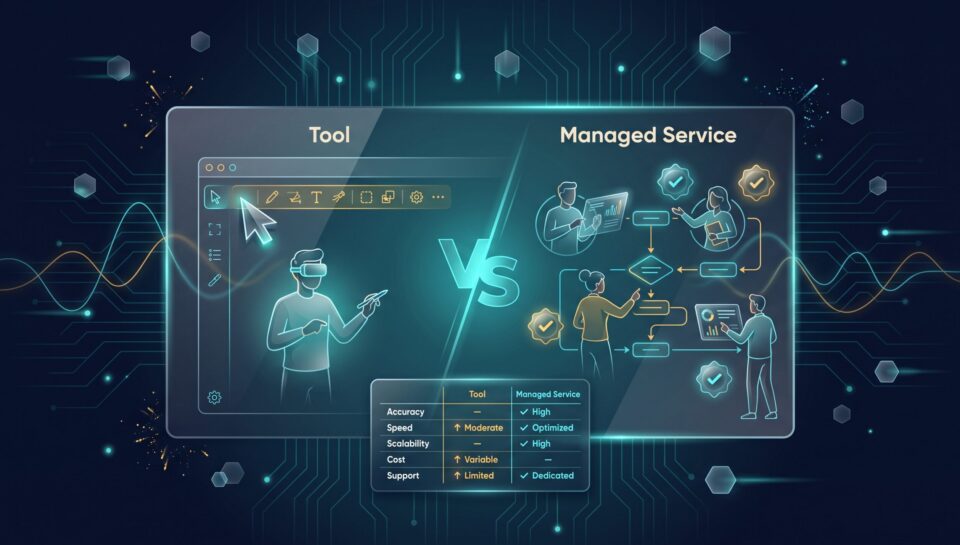
Every team that needs labeled data faces the same fork early on: license a data labeling tool and run the labeling yourself, or hand the whole thing to a managed service. It is a build-versus-buy decision, and teams often make it backward, choosing a tool because it is visible and cheap on paper, then discovering the real cost is the labor and quality control the tool does not provide. This guide is a decision framework, not a tool ranking. It walks through what each path actually gives you, what it costs in full, and which fits which kind of team, so you can make the call deliberately.
For a list of tool categories, ourdata labeling tools page covers the landscape. If you are specifically comparing Labelbox, ourLabelbox comparison goes into that. This piece is about the choice itself.
What a Tool Gives You, and What It Doesn't
A data labeling tool or platform gives you the interface and workflow to label data: the annotation environment, task management, and often some automation like pre-labeling. What it does not give you is the labor, the trained annotators, the quality apparatus, or the project management. You bring all of that. The tool is exactly that, a tool, and someone on your side still has to operate it.
This is the most common misread. A team licenses a tool expecting a solution and gets an empty environment that still needs to be staffed and run. For teams with a standing annotation operation, that is fine and even ideal. For teams without one, it is a surprise.
What a Managed Service Gives You
A managed annotation service gives you labeled data as an outcome. The provider brings the annotators, the guidelines, the quality control, and the project management. You define what you need and review the output. The tooling is the provider's concern, not yours.
The trade is control for offload. You have less hands-on control of the labeling environment, and you gain not having to build and run an annotation operation. For the outsourcing decision in depth, see ourdata labeling outsourcing guide.
The True Cost Comparison
This is where teams go wrong. A tool's license fee is not its total cost. The real cost of the tool path is the license plus your internal labor (annotators, whether employees or contractors you manage), plus the management time to run guidelines and quality control, plus the ramp time to get good at it. A managed service folds all of that into its rate.
The honest comparison is total cost per accepted label, not the headline license or per-label price. A cheap tool with high internal labor and rework can easily cost more than a managed service that looks pricier per label. Ourpricing guide shows how to compute this fairly.
Quality: Who Owns It
With a tool, quality is entirely yours: you design the QA, measure inter-annotator agreement, and catch errors. With a managed service, quality is built into the engagement and reported to you. Neither is automatically better, but they are different: the tool path requires you to have quality discipline; the service path requires you to verify the provider has it. Ourannotation quality guide covers what good quality looks like either way.
Speed and Scale
A tool is as fast as you can staff and train. If you already have an annotation team, that can be immediate; if you are starting from zero, it is slow. A managed service is as fast as the provider can ramp, which is usually quicker for teams without a standing operation, and it flexes with volume spikes more easily than an internal team you have to hire for.
Which Fits Which Team
The decision comes down to a few honest questions. Do you have, or want to build, a standing annotation operation? Is labeling core enough to your product that you want to own it? Do you have the quality discipline in-house? Is your ML team better spent building models or managing annotators?
Teams with a mature annotation operation and ongoing needs often do well with a tool, keeping control and economics in-house. Teams without one, or who would rather their engineers build models, usually do better with a managed service. Many teams run a hybrid: a tool for ongoing routine work they own, a service for spikes, specialized data, or work they would rather offload.
The Hybrid Middle Path
It is worth naming that this is not always either-or. Some teams license a tool and staff the review internally while outsourcing the bulk labeling, or use a service for a project and bring it in-house once volume justifies a standing team. The right answer can change as you scale. What matters is choosing deliberately on total cost, quality ownership, and speed, rather than defaulting to a tool because it is the visible option.
Common Questions From US AI Teams
Should I use a data labeling tool or a managed service?
It depends on whether you have or want a standing annotation operation. A tool gives control but requires you to supply the labor and quality control. A managed service gives labeled data as an outcome. Decide on total cost, quality ownership, and speed.
What is the difference between a data labeling platform and a service?
A platform gives you the tooling to label data; you supply the annotators and quality control. A service supplies all of that as an outcome. The platform is a tool you operate; the service is a result you receive.
Is a data labeling tool cheaper than a managed service?
Not necessarily. A tool's license fee excludes your internal labor, management time, and rework, which are the bulk of the real cost. Compare on total cost per accepted label, not the headline price.
When does a data labeling tool make sense?
When you have a mature annotation team, ongoing labeling needs, and the quality discipline to run it. In that situation a tool gives control and can be economical at scale.
When does a managed service make sense?
When you do not have a standing annotation operation, when you need to start fast, when volume is spiky, or when you would rather your ML engineers build models than manage labeling.
Can I use both a tool and a service?
Yes, and many teams do. A common hybrid is a tool for ongoing routine work you own plus a service for spikes, specialized data, or work you would rather offload. The right mix can change as you scale.
How do I compare the cost of a tool versus a service?
Compute total cost per accepted label for each. For the tool, include license, internal labor, management time, and rework. For the service, use its rate. The path with the lower true cost per usable label wins, which is often not the one with the lower sticker price.
What are alternatives to building labeling in-house?
A managed annotation service is the main alternative, removing the labor and quality-control burden. A hybrid approach, keeping some work in-house on a tool and outsourcing the rest, is also common.
Working With Prudent Partners
Prudent Partners Private Limited is a managed annotation service for US AI teams who would rather receive labeled data than build and run a labeling operation. If you are weighing a tool against outsourcing, we can scope a paid pilot on your real data so you can compare quality and true cost per usable label before deciding. For the full scope, see ourdata annotation services overview.
The first conversation is a 30-minute scoping call about your data, volume, quality bar, and whether a tool, a service, or a hybrid fits best. No commitment to go further.