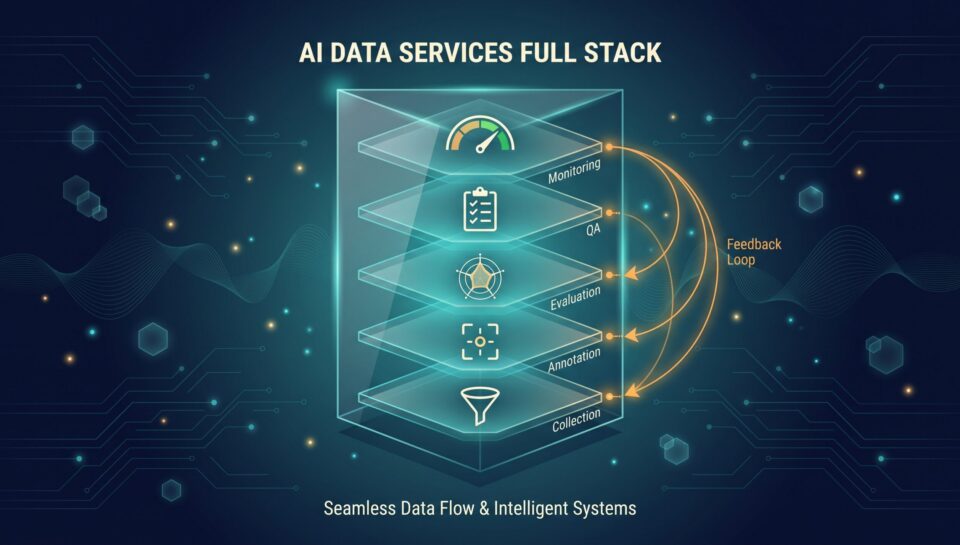
For most of the last decade, "AI data" meant one thing: labeling. A team collected images or text, sent it out for annotation, got labels back, and trained a model. That model of the work is now badly out of date. Modern AI systems, particularly generative and retrieval-based ones, need data support at every stage of their life, and labeling is only one of them. Teams that still think of their data partner as a labeling vendor are usually solving one problem and leaving four others unattended. This guide maps the full stack of AI data services, what each layer does, and how they connect.
The Shift: From Labeling to Lifecycle
The change has a simple driver. Traditional machine learning had a clear boundary: prepare a dataset, train a model, deploy it. Generative and retrieval-based systems blur that boundary. They draw on knowledge bases that need continuous preparation, they are tuned with human feedback rather than only labels, their output has to be evaluated by people because it is open-ended, and they need monitoring in production because quality drifts. The data work never really finishes, and it spans far more than annotation.
Layer 1: Getting the Data
Before anything can be labeled, it has to exist and be usable.
Collection. When the data you need does not exist, it has to be created to a specification: capture conditions, participant profiles, consent, and rights. Ourdata sourcing overview covers where training data comes from.
Sourcing and licensing. Identifying, acquiring, and clearing the rights to existing data, which matters more each year as the legal position on scraped data tightens.
Synthetic generation and validation. Filling gaps that collection cannot reach economically, particularly rare events, then validating that the generated data is actually representative rather than trusting it because it arrived pre-labeled.
Layer 2: Making the Data Usable
Raw data is not training data, and this layer is where most quiet value is created.
Curation. Selecting, cleaning, deduplicating, and balancing so the dataset teaches what you intend. Ourdata curation overview covers the fundamentals.
Annotation and labeling. The traditional core, spanningimage,video,audio, andtext, and increasingly the cross-modal relationships between them. OurAI data annotation services cover the full range.
Knowledge base preparation. For retrieval-based systems, turning documents into something a system can retrieve from reliably: processing, chunking, and metadata structuring. Ourretrieval-augmented generation overview covers the architecture this serves.
Layer 3: Shaping Model Behavior
A newer layer, and the one most teams are least equipped for internally.
Human feedback and alignment. People rating and ranking model outputs so the system learns what good looks like in your context. This is what turns a plausible base model into a helpful, safe, on-brand one, and it is skilled judgment work rather than simple labeling.
Fine-tuning data. Curated, task-specific datasets that give a model consistent domain behavior. OurLLM training data guide covers foundation model preparation.
Safety and policy annotation. Labeling what the system should refuse, escalate, or handle carefully, which is the foundation of any responsible deployment.
Layer 4: Proving It Works
Evaluation has become a discipline in its own right because generative output resists simple testing.
Model evaluation. Measuring correctness, relevance, faithfulness, safety, tone, and consistency as separate signals, combining automatic metrics with structured human review.
Benchmarking. Comparing against baselines and alternatives to inform real decisions about which model or approach to use.
Quality measurement. The discipline underneath all of it: clear rubrics, trained reviewers, and measured agreement so scores are reliable rather than one person's opinion. Ourannotation quality and inter-annotator agreement guide covers the method.
Layer 5: Keeping It Working
The layer teams discover last, usually through a customer complaint.
Production quality monitoring. Sampling real output and reviewing it against the same criteria used before launch, because model updates and shifting inputs degrade quality quietly. OurAI quality assurance function covers this.
Content and output moderation. Reviewing what a live system produces for safety and policy compliance, covered in ourcontent moderation services.
Feedback loops. Routing problems found in production back into the data, tuning, and evaluation sets. This loop is the difference between a system that improves over time and one that erodes.
Why the Layers Matter Together
The layers are connected, and treating them separately is where projects fail. Evaluation findings should reshape curation. Production failures should become training data. Weak knowledge base preparation surfaces as a model problem and gets misdiagnosed as one. Teams that use different vendors for each layer, or handle some layers and ignore others, end up with a data operation that cannot learn from itself.
The practical implication is not that every team needs every layer from one provider. It is that someone has to be responsible for the connections, and the more layers a partner covers, the fewer seams there are for problems to hide in.
What to Keep and What to Partner On
Most teams keep the model, the architecture, and the product decisions in-house, because those are close to the product and hard to externalize. The data layers are more commonly partnered because the work is labor-intensive, demand is spiky around releases, quality benefits from a dedicated operation, and independent evaluation carries more weight than a team assessing its own system. The decision should rest on total cost per usable outcome, control, and what is genuinely core to your product, the same framing covered in ourpricing guide andvendor evaluation guide.
The Question Worth Asking
If you are working with a data partner today, the useful question is not whether they label well. It is how many of these layers they can actually support, and whether anyone is responsible for the connections between them. For a team still training conventional models, a labeling vendor may be entirely sufficient. For a team building generative or retrieval-based systems, it usually is not, and the gap tends to surface late.
Common Questions From US AI Teams
What are AI data services?
The full range of data work supporting an AI system: collection and sourcing, curation and annotation, knowledge base preparation, human feedback and tuning data, evaluation and benchmarking, and production quality monitoring. Labeling is one layer of several.
How is this different from data annotation?
Annotation is one layer. The full stack also covers getting the data, making it usable, shaping model behavior through human feedback, proving the system works through evaluation, and keeping quality from drifting in production.
Why has AI data work expanded beyond labeling?
Because generative and retrieval-based systems blur the old boundary between preparation and deployment. They need continuously prepared knowledge, human feedback rather than only labels, human evaluation of open-ended output, and ongoing production monitoring.
Do we need all these layers?
Not necessarily. A team training conventional models may need only collection, curation, and annotation. Teams building generative or retrieval-based systems typically need the tuning, evaluation, and monitoring layers too.
Should we use one partner for all layers or specialists for each?
Specialists can each do good work, but the layers are connected and someone has to own the connections. The more layers a partner covers, the fewer seams there are for problems to hide in.
Which layer do teams most often overlook?
Production monitoring. Quality degrades quietly as models update and inputs shift, and teams usually discover the problem through customer complaints rather than measurement.
What should stay in-house?
Most teams keep the model, architecture, and product decisions in-house. The data layers are more commonly partnered because the work is labor-intensive, spiky, and benefits from a dedicated operation with independent judgment.
How do we evaluate an AI data partner today?
Ask how many layers they genuinely support, how they measure quality across each, whether findings from evaluation and production flow back into the data, and whether they will prove all of it on a paid pilot.
Working With Prudent Partners
Prudent Partners Private Limited works across the AI data stack for US teams: sourcing and collection, curation andannotation across every modality, knowledge base preparation for retrieval systems, human feedback and tuning data, evaluation with measured reviewer agreement, and ongoingquality assurance in production.
The first conversation is a 30-minute scoping call about what you are building, which layers you already cover, and where the gaps are. No commitment to go further.