
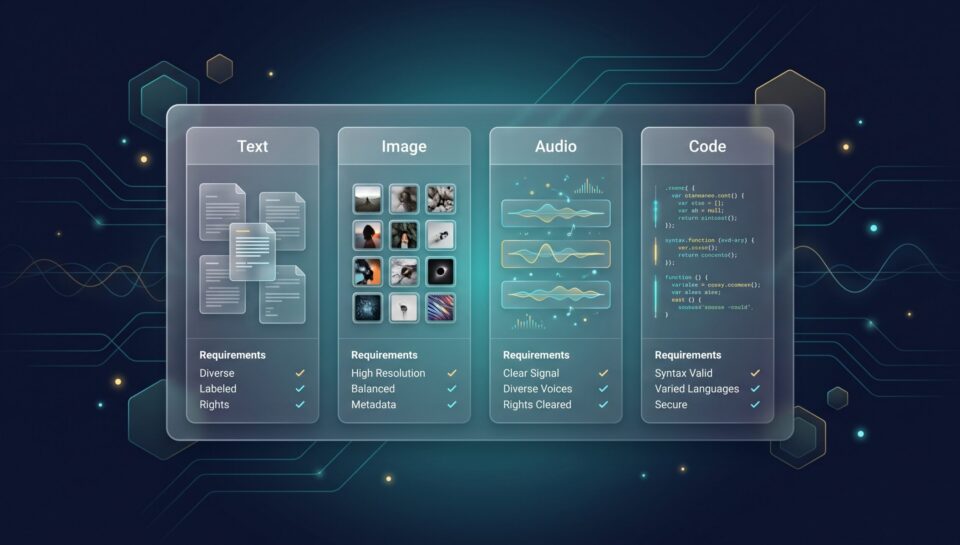
Labeling data for a generative model is not the same job as labeling data for a classifier, and teams that treat it as the same job produce datasets that technically meet spec and fail to improve the model. A classifier needs to know what something is. A generative model needs to learn how to produce something, which means the data has to carry information about quality, style, structure, and preference, not just category. This guide covers what generative models need from each modality and where the work differs from traditional annotation.
The Core Difference
Traditional annotation answers a closed question: which class, which box, which entity. Generative training data answers open ones: what is a good response here, what makes this output better than that one, what does the desired style look like. The label is often a judgment or a demonstration rather than a category, which changes who can do the work and how quality is measured. Ourdata annotation services cover the traditional foundation this builds on.
Text
Text remains the largest generative modality and the one with the most varied data requirements.
Instruction and response pairs. Demonstrations of the task done well, which teach the model what a good answer looks like for your domain. Quality here is dominated by the quality of the demonstrations, and mediocre demonstrations teach mediocrity efficiently.
Preference comparisons. Judgments about which of two responses is better, and why. This is what shapes helpfulness, tone, and refusal behavior, and it requires reviewers who can articulate why one answer beats another rather than just picking.
Domain adaptation data. Text that carries the vocabulary, conventions, and reasoning patterns of your field, prepared so the model absorbs the domain rather than a generic register.
Safety and refusal data. Examples of what the model should decline and how it should decline, which is a specific labeling task most teams underinvest in until something goes wrong.
Ourtext annotation andtext classification work covers the underlying capabilities.
Image
Generative image models learn from images paired with language, which makes the language the hard part.
Descriptive captioning. Detailed, accurate descriptions of what an image contains, including composition, style, and relationships, not just objects. The richness of the caption largely determines what the model can be prompted to produce.
Attribute and style labeling. Consistent vocabulary for style, lighting, composition, and quality, so the model learns controllable dimensions rather than an undifferentiated blend.
Quality and preference judgments. Which generated images are better, used to tune output quality. This is subjective work requiring consistent criteria and measured agreement, or it produces noise.
Ourimage annotation capability covers the foundational work.
Video
Video is the fastest-growing and most demanding generative modality.
Temporal descriptions. Describing not just what appears but what happens and in what sequence, since generative video models must learn motion and causality rather than appearance alone.
Scene and shot structure. Labeling transitions, camera movement, and pacing, which are the controllable dimensions of generated video.
Consistency judgments. Assessing whether generated video maintains coherent subjects, physics, and continuity across frames, which is the dominant failure mode and requires careful human review.
Ourvideo annotation work covers the base capability.
Audio
Audio generative work splits between speech and general audio.
Transcription with prosody. Not just words but delivery: emphasis, pacing, emotion, which speech generation models need to sound natural rather than flat.
Speaker and style characterisation. Consistent labeling of voice qualities so the model learns controllable characteristics.
Quality preference. Judging naturalness and artifacts in generated audio, which is perceptual work where consistent criteria matter enormously.
Ouraudio annotation capability covers the foundation.
What Is Common Across All Four
Three requirements recur regardless of modality.
Judgment over categorisation. Most generative data work involves assessing quality or preference, which needs reviewers capable of consistent judgment and rubrics that make judgment repeatable.
Consistency is the binding constraint. Inconsistent preference data is worse than less data, because it teaches the model contradictory lessons. Measured agreement between reviewers is therefore not a nicety here, it is the thing that makes the dataset usable. Ourannotation quality guide covers the method.
Coverage of the hard cases. Generative models fail at edges, so data that only covers typical cases produces a model that only handles typical cases.
A Practical Sequence
Teams generally get more value by starting with a modest, high-quality demonstration set than with a large mediocre one, then adding preference data to refine behavior, then adding safety and refusal data before exposure to real users, then expanding coverage based on where evaluation shows failures. Building coverage first and quality later is the common and expensive inversion.
Common Questions From US AI Teams
How is generative training data different from traditional annotation?
Traditional annotation answers closed questions like which class or which box. Generative data captures judgment and demonstration: what a good output looks like and why one is better than another.
What does a generative text model need beyond raw text?
Instruction and response demonstrations, preference comparisons between responses, domain adaptation data carrying your field's conventions, and explicit safety and refusal examples.
Why does captioning matter so much for image generation?
Because the language paired with an image determines what the model can be prompted to produce. Rich, accurate descriptions covering composition and style expand controllability; thin captions limit it.
What makes video the hardest generative modality?
It requires temporal description of what happens in sequence, labeling of shot structure and camera movement, and human judgment of cross-frame consistency, which is the dominant failure mode.
What does audio generation need beyond transcription?
Prosody, meaning emphasis, pacing, and emotion, plus consistent speaker and style characterisation and perceptual quality judgments on generated output.
Why is consistency more important than volume in generative data?
Because inconsistent preference data teaches contradictory lessons. A smaller consistent dataset outperforms a larger contradictory one, which makes measured reviewer agreement essential rather than optional.
Who should do generative labeling work?
People capable of consistent judgment against a rubric, and for domain-specific work, people who understand the domain. It is closer to skilled review than to categorisation.
What order should we build generative datasets in?
A modest high-quality demonstration set first, then preference data, then safety and refusal data before user exposure, then coverage expansion driven by evaluation findings.
Working With Prudent Partners
Prudent Partners Private Limited prepares generative AI training data across every modality: instruction and preference data fortext, descriptive captioning and style labeling forimage, temporal and consistency work forvideo, and prosody and perceptual quality foraudio, with measured reviewer agreement so preference data is consistent enough to be useful.
The first conversation is a 30-minute scoping call about your model, your modalities, and the behavior you are trying to shape. No commitment to go further.