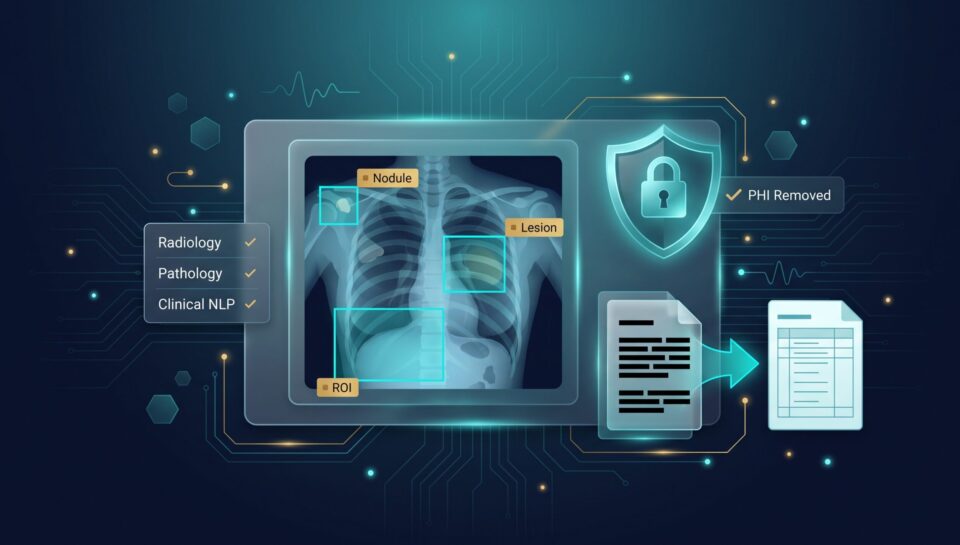
Healthcare AI has a data problem that other domains do not: the training data is protected health information, and mishandling it is not just a quality issue but a legal one. A model that reads chest X-rays, flags sepsis risk, or transcribes clinical notes has to be trained on real medical data, and that data falls under HIPAA. So the question US healthcare AI teams ask is not only “who can annotate this well” but “who can annotate this without creating a compliance exposure.” This guide covers how medical data annotation works under HIPAA, what to require of a partner, and how the compliance layer fits alongside annotation quality.
For medical annotation in general, our medical data annotation page covers the modalities and use cases. This piece is about the compliance dimension specifically.
Why Medical Annotation Is Different
Medical data annotation carries everything ordinary annotation does, plus a regulatory layer that changes how the work has to be run. The data is protected health information: patient records, medical images with identifiers, clinical notes, and audio that may contain names and conditions. Under HIPAA, this data can only be handled by parties with the right agreements and safeguards, and a breach carries real penalties. That reality shapes the whole operation, from who can see the data to where it is stored to how it is transmitted.
The HIPAA Building Blocks
A few concepts define compliant medical annotation.
Protected Health Information (PHI). The identifiable health data HIPAA protects. Annotation work has to treat it accordingly at every step.
Business Associate Agreement (BAA). When a healthcare organization shares PHI with a vendor, HIPAA requires a BAA, a contract that binds the vendor to protect the data. A medical annotation partner that cannot sign a BAA cannot compliantly handle your PHI. This is a hard gate, not a nice-to-have.
De-identification. Removing or masking the identifiers that make health data traceable to a person. Where the annotation task allows, working with de-identified data reduces risk substantially. A good partner helps determine what can be de-identified without destroying the data’s value for the model.
Minimum necessary. HIPAA’s principle that only the data actually needed for the task should be used and seen. A disciplined annotation operation applies this by limiting access to what each annotator needs.
Security Controls for Medical Annotation
Beyond the agreements, the operational security has to match. Expect ISO 27001 certified information security operations as a baseline, role-based access with full audit logging so every touch of PHI is traceable, secure data handling and transmission, and workforce controls including NDAs, background checks, and HIPAA training for annotators. For the broader security-comparison discipline, our vendor evaluation guide covers what to ask.
Compliance Does Not Replace Quality
An important point: HIPAA compliance is necessary but not sufficient. A partner can be perfectly compliant and still produce poor labels. Medical annotation demands both the compliance layer and genuine domain quality: annotators who understand medical context, measurable inter-annotator agreement (see our annotation quality guide), and often clinical review of the hard cases. In medicine, a labeling error is not a small accuracy hit; it can shape a model that affects care. The quality bar is correspondingly high.
Modalities in Medical Annotation
Medical annotation spans several data types, each with its own compliance and quality considerations: medical imaging (X-ray, CT, MRI) with segmentation and findings labels, clinical text and notes with entity and concept labeling, medical audio and dictation, and structured clinical data. Our medical image annotation page covers the imaging side in more depth.
How to Choose a HIPAA-Compliant Annotation Partner
The gating questions: will you sign a BAA; are you ISO 27001 certified with PHI-appropriate controls; how do you handle de-identification and minimum-necessary access; what is your annotators’ medical training and quality measurement; and will you demonstrate both compliance and label quality on a paid pilot. A partner who leads with compliance evidence and can also show quality metrics is the combination healthcare AI requires.
Common Questions From US Healthcare AI Teams
What is HIPAA-compliant data annotation?
It is medical data annotation run under HIPAA safeguards: a signed Business Associate Agreement, PHI-appropriate security controls, de-identification where possible, minimum-necessary access, and trained annotators. It ensures protected health information is handled lawfully during labeling.
Do I need a BAA with my annotation vendor?
Yes, if the vendor will handle protected health information. HIPAA requires a Business Associate Agreement whenever a healthcare organization shares PHI with a vendor. A partner who cannot sign one cannot compliantly handle your PHI.
Can medical data be de-identified before annotation?
Often, yes, and it reduces risk substantially. Where the task allows, working with de-identified data is preferable. A good partner helps determine what can be de-identified without destroying the data’s value for the model.
What security should a medical annotation partner have?
ISO 27001 certified operations, role-based access with full audit logging, secure data handling and transmission, and workforce controls including NDAs, background checks, and HIPAA training. Compliance agreements and operational security both matter.
Is HIPAA compliance enough on its own?
No. Compliance is necessary but not sufficient. A partner can be compliant and still produce poor labels. Medical annotation requires both the compliance layer and genuine domain quality, including medical understanding and measurable agreement.
What types of medical data get annotated?
Medical imaging like X-ray, CT, and MRI, clinical text and notes, medical audio and dictation, and structured clinical data. Each has its own compliance and quality considerations.
How is quality ensured in medical annotation?
Through annotators with medical understanding, measurable inter-annotator agreement, and clinical review of hard cases. In medicine the stakes make rigorous quality control mandatory rather than optional.
How do I choose a HIPAA-compliant annotation partner?
Confirm they will sign a BAA, are ISO 27001 certified with PHI-appropriate controls, handle de-identification and minimum-necessary access, have medically-trained annotators with quality measurement, and will demonstrate both compliance and quality on a paid pilot.
Working With Prudent Partners
Prudent Partners Private Limited provides medical data annotation for US healthcare AI teams with ISO 27001 information security operations, PHI-appropriate access controls, and a documented quality framework spanning medical imaging, clinical text, and medical audio. For medical annotation in general, see our medical data annotation page, and for the full scope, our data annotation services overview.
The first conversation is a 30-minute scoping call about your data types, compliance requirements, and quality bar. No commitment to go further.