Every labeling process produces errors. The question is not whether your training data has mislabeled examples, it does, but whether you catch them before they teach your model the wrong thing. This is what annotation auditing does: a human-in-the-loop review layer that finds and fixes labeling errors, whether the labels came from your own team, an automated tool, or a previous vendor. For US AI teams who have inherited a questionable dataset or want to trust the one they are building, auditing is the difference between hoping the data is good and knowing it.
If your question is whether to automate labeling in the first place, our piece on AI-assisted labeling tradeoffs covers that decision. This one is about the layer that keeps quality honest no matter how the labels were produced.
Why Errors Are Inevitable, and Why That Is Fine
Labeling is a judgment task, and judgment varies. Two careful annotators will disagree on genuinely ambiguous cases; a tired annotator will slip; an automated pre-labeling model will confidently mislabel the edge cases it was never good at. None of this is a sign of a broken process. It is the normal texture of annotation work. What separates a trustworthy dataset from an untrustworthy one is not the absence of errors but the presence of a system that catches them.
What Human-in-the-Loop Auditing Actually Is
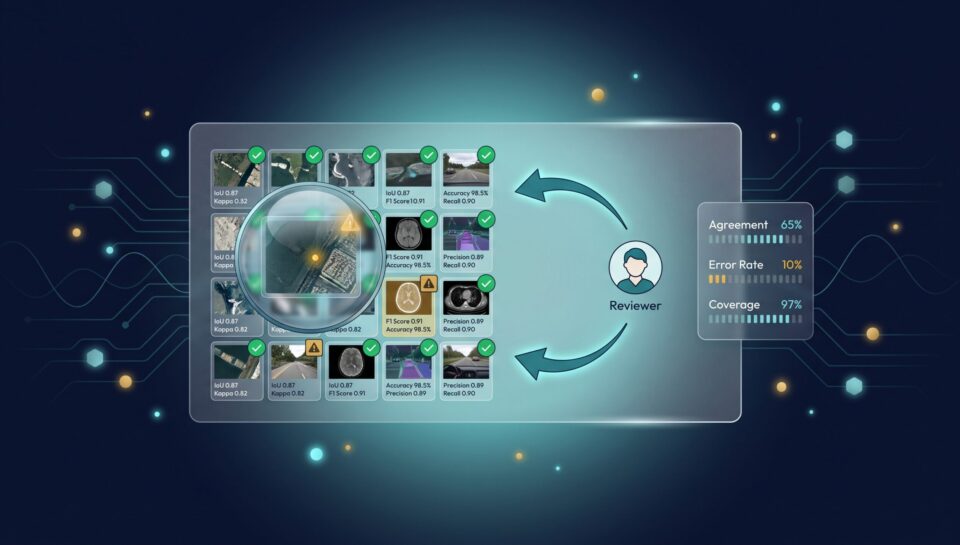
Human-in-the-loop auditing combines automated error detection with human judgment. The automated layer flags likely errors: labels that disagree with a model’s prediction, statistical outliers, examples where annotators disagreed, and cases that violate defined rules. The human layer then reviews those flagged cases and makes the call, because the flag is a suspicion, not a verdict. The automation narrows millions of labels down to the few thousand worth a human’s attention; the human resolves them. Neither works well alone. Automation alone produces false alarms and misses context; humans alone cannot review everything at scale.
This directly answers what US teams are searching for when they look for a service supporting “automated error detection and human-in-the-loop review”: the two are a pair, not alternatives.
The Auditing Workflow
A real auditing pass has structure. It starts by defining what “correct” means for your task, because you cannot audit against an undefined standard. It samples or scans the dataset with automated detectors to surface suspect labels. It routes those to human reviewers, ideally reviewers who did not produce the original labels, to avoid rubber-stamping. It corrects the confirmed errors and, importantly, feeds the pattern back: if a class of errors keeps appearing, the guidelines or the pre-labeling model need fixing, not just the individual labels. Our guide on inter-annotator agreement covers the metrics that make this measurable rather than impressionistic.
Auditing a Dataset You Already Have
A common and underserved case: you have a dataset, maybe built in-house, maybe from a previous vendor, and you are not sure you trust it. Auditing an existing dataset is its own service. It starts with a sampled quality assessment to estimate the error rate, then a targeted cleanup of the problem areas the assessment surfaces. This is often far cheaper than relabeling from scratch, because most of the data is usually fine and the effort concentrates where it is not. If you have ever suspected a dataset is holding your model back but did not want to throw it away, this is the path.
When Auditing Pays for Itself
Auditing has a cost, and it is worth being honest about when it is worth it. It pays off when errors are expensive: safety-critical applications, regulated domains, models going to production, or datasets you will reuse across many projects. It is less essential for throwaway experiments or low-stakes prototypes. The cost calculation is straightforward: compare the cost of the audit against the cost of a model trained on bad data, which is usually much higher and paid later.
Choosing an Auditing Partner
If you are evaluating a data-cleanup and annotation auditing service, the questions are: do you combine automated error detection with human review, or just one; do your reviewers work independently of the original labelers; how do you measure and report the error rate before and after; and will you run a sampled assessment first so I can see the real error rate before committing to a full cleanup. Our vendor evaluation guide covers the broader vetting; these are the auditing-specific additions.
Common Questions From US AI Teams
What is human-in-the-loop annotation auditing?
It is a review layer that combines automated error detection with human judgment to find and fix labeling errors. The automation flags suspect labels; humans review and resolve them. Together they catch errors that neither would alone.
How do I catch labeling errors before they reach my model?
Run an auditing pass: define what correct means, use automated detectors to flag likely errors, have independent reviewers confirm and correct them, and feed recurring patterns back into your guidelines. The goal is a system that catches errors, not the impossible goal of never making them.
Can I audit a dataset I already have?
Yes. Auditing an existing dataset starts with a sampled assessment to estimate the error rate, then a targeted cleanup of the problem areas. It is often much cheaper than relabeling from scratch, since most of the data is usually fine.
What is the difference between AI-assisted labeling and annotation auditing?
AI-assisted labeling is about producing labels faster using automation. Auditing is about verifying labels are correct, however they were produced. You can and often should use both: automation to label, auditing to check.
How does automated error detection work in annotation QA?
It flags labels that disagree with a model’s prediction, statistical outliers, cases where annotators disagreed, and rule violations. These flags are suspicions that a human then reviews, not automatic corrections.
When is annotation auditing worth the cost?
When errors are expensive: safety-critical or regulated applications, models going to production, or datasets reused across projects. Compare the audit cost against the cost of a model trained on bad data, which is usually far higher.
Should reviewers be different from the original annotators?
Yes, where possible. Independent reviewers avoid the rubber-stamping that happens when people check their own work. It is a simple control that meaningfully improves what auditing catches.
How do I choose an annotation auditing service?
Confirm it combines automated detection with human review, uses independent reviewers, measures and reports error rates before and after, and will run a sampled assessment first so you can see the real error rate before committing to a full cleanup.
Working With Prudent Partners
Prudent Partners Private Limited provides human-in-the-loop annotation auditing: automated error detection paired with independent human review, measurable error-rate reporting, and sampled assessments so you can see a dataset’s real quality before committing to a cleanup. We audit datasets built in-house or by a previous vendor, as well as the work we produce. For the full scope, see our data annotation services overview, and for the labeling-automation decision, our AI-assisted labeling tradeoffs piece.
The first conversation is a 30-minute scoping call, and for auditing we can start with a sampled assessment of your existing data. No commitment to go further.