
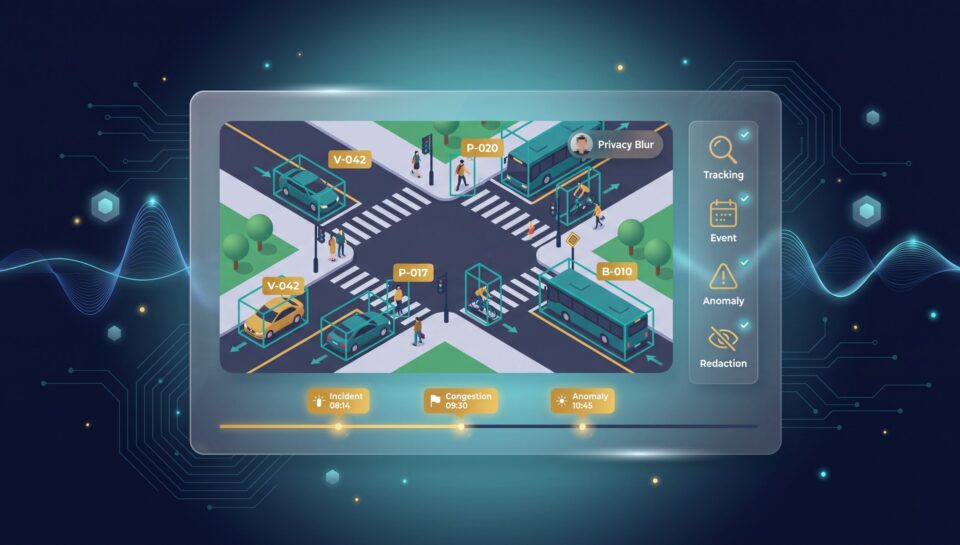
Cities are becoming instrumented. Traffic cameras, transit sensors, public-space monitoring, and infrastructure inspection all generate video, and increasingly that video feeds AI systems that detect incidents, manage traffic, and support public safety. Those systems learn from annotated video, and the annotation is demanding: the footage runs continuously, objects have to be tracked across frames and cameras, and the privacy stakes are high because the subjects are the public. This guide covers what video annotation for smart cities and public safety involves, the annotation types it needs, the privacy dimension, and how to choose a partner for city-scale video work.
For video annotation in general, our video annotation page covers the fundamentals, and our piece on how video annotation powers urban governance covers the policy side. This guide is the practical, application-focused version.
What Smart-City Video AI Needs From Annotation
Smart-city and public-safety AI covers a range of applications, each with its own annotation demands. Traffic management needs vehicles, pedestrians, and signals tracked over time. Incident detection needs events like collisions, stalls, or crowd surges labeled with precise timing. Infrastructure monitoring needs defects and hazards marked. Public-safety analytics needs objects and activities recognized, often in real time. The common thread is that this is video, not stills, so the annotation has to handle motion and continuity, not just single frames.
The Annotation Types Involved
Object detection and tracking. Marking and following vehicles, people, and objects across frames, so the model learns motion, not just presence. This temporal tracking is the core of city-scale video work.
Event and activity labeling. Tagging what happens and when: a collision, a vehicle running a red light, a crowd forming, a person entering a restricted area. Precise start and end timing matters.
Semantic segmentation. Labeling scene regions (road, sidewalk, building, vehicle) so a model understands the environment, useful for traffic and infrastructure applications.
Multi-camera consistency. In a city deployment the same object may appear across several cameras, and the annotation has to keep it consistent, which is harder than single-camera work.
For the technical detail on tracking objects across frames, the same temporal-consistency discipline applies as in autonomous vehicle work; our AV annotation guide covers that in depth.
The Privacy Dimension
Public video is sensitive by nature: the subjects are ordinary people who did not opt in. Responsible smart-city annotation takes this seriously. That means de-identification where the task allows (blurring faces and plates that are not needed for the label), minimum-necessary access so annotators see only what the task requires, secure handling of footage, and clear documentation. The privacy posture is not a bolt-on; for public-safety work it is central to whether a deployment is acceptable at all. A partner should carry ISO 27001 information security operations and be able to speak to how it handles public-space footage specifically.
Scale and Continuity
City video is high-volume and continuous, which changes the annotation operation. The work is ongoing rather than a one-time batch, quality has to hold across long stretches of footage and many annotators, and turnaround often matters because the models feed operational systems. A partner used to project-based image labeling is not automatically equipped for continuous city-scale video. Ask specifically about throughput, consistency over time, and how quality is maintained at volume. Our annotation quality guide covers the measurement that makes this trackable.
How to Choose a Partner for Smart-City Video
The questions that matter: can you handle continuous, high-volume video, not just image batches; how do you maintain object tracking and consistency across frames and cameras; how do you handle privacy and de-identification of public footage; what is your security posture; and how do you keep quality consistent at scale over time. Our broader vendor evaluation guide covers the rest.
Common Questions From US Smart-City and Public-Safety Teams
What is video annotation for smart cities?
It is labeling city-scale video so AI systems can detect incidents, manage traffic, and support public safety. It includes object tracking across frames, event labeling with precise timing, scene segmentation, and multi-camera consistency.
How is video annotation different from image annotation?
Video is continuous, so objects must be tracked across frames rather than labeled in isolation, and events need precise start and end timing. This temporal dimension makes video annotation more demanding than single-frame image work.
What annotation types do public-safety AI systems need?
Object detection and tracking, event and activity labeling with timing, semantic segmentation of the scene, and multi-camera consistency, depending on the application. Traffic, incident detection, and infrastructure monitoring each emphasize different types.
How is privacy handled in public video annotation?
Through de-identification where the task allows (blurring faces and plates not needed for the label), minimum-necessary access, secure footage handling, and documentation. For public-space video the privacy posture is central, not optional.
Can a video annotation partner handle city-scale volume?
Not all can. City video is continuous and high-volume, which is a different operation from project-based image labeling. Confirm a partner’s throughput, consistency over time, and quality maintenance at scale before committing.
Why does object tracking matter in city video?
Because the model needs to learn motion and continuity, not just presence. Tracking the same object consistently across frames and cameras is what lets a system understand traffic flow, incidents, and activity over time.
What security should a smart-city video partner have?
ISO 27001 information security operations, secure handling of footage, minimum-necessary access, and a clear approach to public-space privacy. Given the sensitivity of public video, the security and privacy posture is a primary selection criterion.
How do I choose a smart-city video annotation partner?
Confirm they handle continuous high-volume video, maintain tracking and multi-camera consistency, take privacy and de-identification seriously, carry appropriate security, and keep quality consistent at scale. Require a paid pilot on your real footage.
Working With Prudent Partners
Prudent Partners Private Limited provides video annotation for US smart-city and public-safety AI, including object tracking, event labeling, and segmentation at scale, with privacy-conscious handling of public footage and ISO 27001 information security operations. For video annotation in general, see our video annotation page, and for the full scope, our data annotation services overview.
The first conversation is a 30-minute scoping call about your video sources, volume, applications, and privacy requirements. No commitment to go further.