
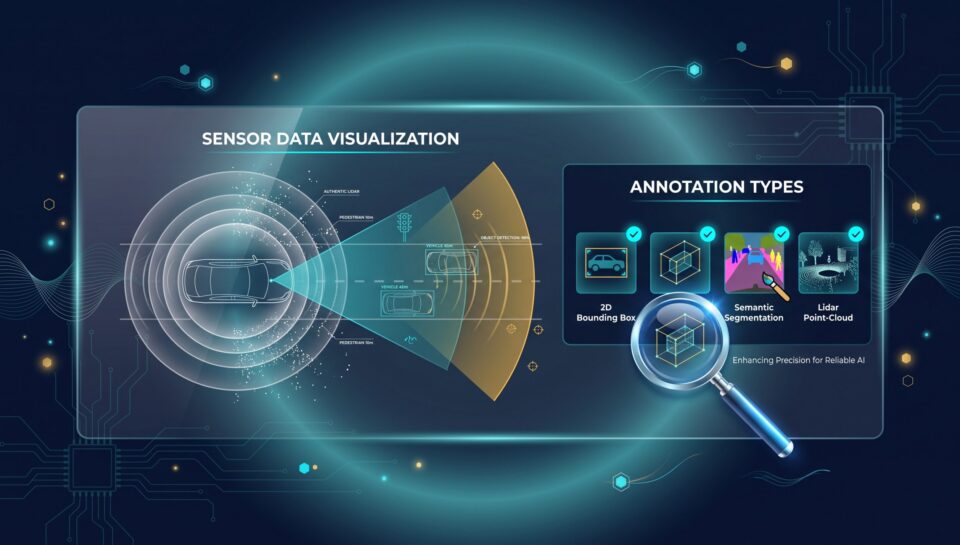
An autonomous vehicle sees the world through a stack of sensors, and every one of them produces data that has to be labeled before a perception model can learn from it. The quality of that labeling is not a detail. It is the difference between a system that reliably distinguishes a pedestrian from a shadow and one that does not. This guide explains the main annotation types used in autonomous driving and how they map to the sensors on the vehicle, so that AV and ADAS teams evaluating a data partner know what they are actually asking for.
If you are looking for an overview of ADAS features rather than the annotation behind them, our ADAS data annotation guide covers that. This piece is about the labeling itself.
The Sensor Stack, and Why Each Needs Different Annotation
Autonomous and driver-assistance systems fuse several sensor types, and each produces a different kind of data that calls for a different kind of annotation.
Cameras produce 2D images. These are labeled with 2D bounding boxes, polygons, and semantic segmentation. Cameras are rich in detail and color but weak on precise distance.
Lidar produces 3D point clouds. These are labeled with 3D cuboids and point-level segmentation. Lidar gives accurate geometry and distance but no color and less texture. Our 3D point cloud annotation piece goes deeper on this modality.
Radar produces sparse returns useful for velocity and works in weather that blinds cameras and lidar. It is often fused with the others rather than annotated alone.
The reason this matters for a buyer: a vendor who can label camera images is not automatically a vendor who can label lidar point clouds or handle sensor fusion. Those are different competencies, and AV work usually needs all of them.
The Main Annotation Types, Explained
2D bounding boxes draw a rectangle around each object in a camera image. Fast and widely used for detection, and the entry point most teams start with. The live demand for “2d bounding box annotation for autonomous vehicles” reflects how foundational this is.
Polygons and instance segmentation trace the exact outline of an object, which matters when a rectangle is too coarse, such as an irregularly shaped vehicle or a pedestrian partly behind a pole.
Semantic segmentation labels every pixel by class (road, sidewalk, vehicle, pedestrian, sky). This is what lets a system understand drivable space, not just discrete objects.
3D cuboids place an oriented box around an object in lidar space, capturing position, size, and heading. This is what feeds distance and trajectory estimation.
Point-level 3D segmentation classifies individual lidar points, the 3D analog of pixel segmentation, used for fine-grained scene understanding.
Sensor fusion annotation links the same object across camera, lidar, and radar in the same scene, so the labels agree across modalities. This is the hardest and most valuable, because a perception model that fuses sensors needs training data where the fusion is already consistent.
Temporal Consistency: The AV-Specific Hard Part
Driving data is video, not stills, and objects have to be tracked consistently frame to frame. A car labeled in frame one has to be the same tracked car in frame fifty. Inconsistent tracking teaches a model that objects flicker in and out of existence, which is exactly the failure mode you cannot afford in a moving vehicle. Temporal consistency is a quality dimension that AV annotation has and most other annotation does not.
Why Quality Control Is Non-Negotiable Here
In most annotation, a labeling error is a small hit to model accuracy. In autonomous driving, the cost of certain errors is categorically higher, which is why AV annotation runs on strict, measurable quality control: high inter-annotator agreement, gold-standard scenes, and review tiers weighted toward safety-critical classes like pedestrians and cyclists. Our annotation quality guide covers the measurement; in AV the stakes just make it mandatory rather than merely good practice.
What to Ask an AV Annotation Vendor
Can you handle all our sensor modalities, not just camera. How do you maintain temporal consistency across frames. What is your inter-annotator agreement on safety-critical classes. How do you handle sensor fusion labeling. Can you prove it on a pilot with our data. Our vendor vetting checklist covers the procurement side; these are the AV-specific additions.
Common Questions From AV and ADAS Teams
What is 2D bounding box annotation for autonomous vehicles?
It is drawing a rectangle around each object in a camera image so a detection model can learn to locate vehicles, pedestrians, and other objects. It is the most common starting point for AV perception data and the foundation most teams build on.
What annotation types do autonomous vehicles need?
Usually a combination: 2D boxes and segmentation for camera images, 3D cuboids and point-level segmentation for lidar, and sensor fusion annotation to keep labels consistent across modalities. Which mix depends on your sensor stack.
What is the difference between 2D and 3D annotation for AV?
2D annotation labels objects in flat camera images. 3D annotation labels objects in lidar point clouds, capturing real-world position, size, and heading. AV systems typically need both, since cameras and lidar see complementary things.
What is sensor fusion annotation?
It links the same object across camera, lidar, and radar in one scene so the labels agree across sensors. It is the hardest annotation type and the most valuable for systems that fuse sensor inputs, because the training data has to reflect that fusion.
Why does temporal consistency matter in AV annotation?
Driving data is video, and objects must be tracked as the same object across frames. Inconsistent tracking teaches a model that objects appear and disappear, a dangerous failure mode in a moving vehicle. It is a quality dimension specific to AV.
How do I choose an autonomous driving data annotation vendor?
Confirm they handle all your sensor modalities, ask how they maintain temporal consistency and inter-annotator agreement on safety-critical classes, and require a paid pilot on your data. Camera labeling ability alone does not mean lidar or fusion ability.
What quality standards apply to AV annotation?
Higher than most, because certain errors carry safety consequences. Expect high inter-annotator agreement, gold-standard scenes, and review weighted toward pedestrians, cyclists, and other safety-critical classes.
Can one vendor handle camera, lidar, and radar annotation?
Some can, many cannot. These are distinct competencies. If your stack fuses sensors, confirm the vendor can label all of them and keep the labels consistent across modalities, rather than assuming camera skill transfers.
Working With Prudent Partners
Prudent Partners Private Limited provides autonomous vehicle and ADAS data annotation across camera, lidar, and radar, including 2D boxes, 3D cuboids, segmentation, and sensor fusion, with the temporal consistency and safety-weighted quality control AV work demands. For our AV services, see AI data annotation for autonomous vehicles in the USA, and for the full scope, our data annotation services overview.
The first conversation is a 30-minute scoping call about your sensor stack, the annotation types you need, and your quality bar. No commitment to go further.