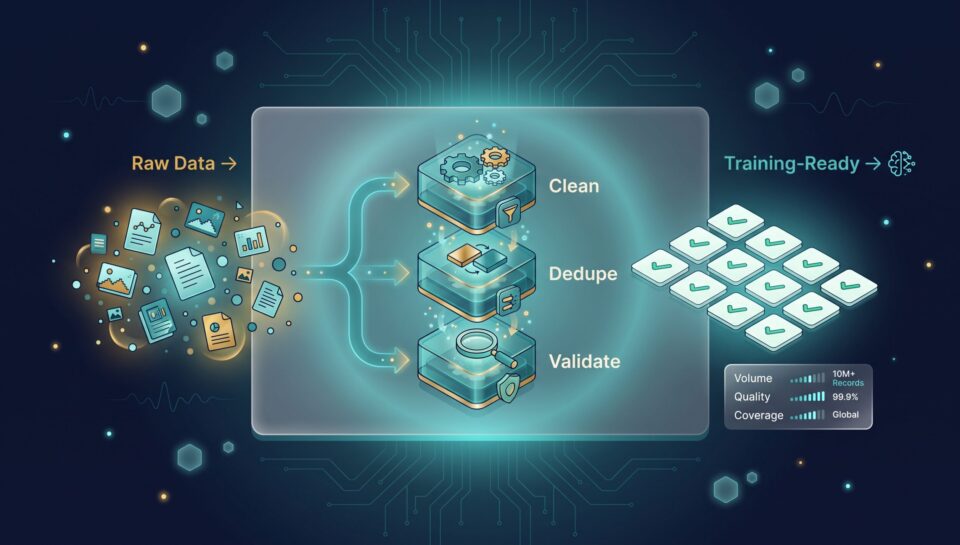
Most AI teams have more data than they can use. The problem is rarely quantity; it is that raw data is messy, inconsistent, duplicated, mislabeled, and full of examples that will actively hurt a model if left in. Data curation is the discipline of turning that raw pile into a clean, representative, training-ready dataset. It is unglamorous work, and it is also where a lot of the real gains in model quality come from, because a smaller well-curated dataset routinely beats a larger messy one. This guide covers what data curation involves for AI, the practices that matter, and how US teams decide whether to do it in-house or outsource it.
For the definition of the term, our data curation page covers it. This piece is about doing it well.
What Data Curation Actually Involves
Data curation for AI is the end-to-end process of selecting, cleaning, organizing, and maintaining data so it is fit to train a model. It sits between raw data collection and model training, and it usually includes several steps.
Selection and filtering. Deciding what belongs in the dataset and what does not. Not all data helps; some actively hurts. Curation starts by choosing the data that reflects the problem you are solving.
Cleaning. Fixing or removing corrupted, malformed, and low-quality examples. Bad inputs teach bad behavior.
Deduplication. Removing exact and near-duplicate examples, which waste training effort and can leak between training and evaluation sets, making a model look better than it is.
Labeling and relabeling. Ensuring examples are correctly and consistently labeled, which is where curation meets annotation. Our guide on annotation quality covers the measurement side.
Balancing and representativeness. Making sure the dataset reflects the real distribution the model will face, and that no class or group is badly over- or under-represented, which is a direct lever on bias in the resulting model.
Documentation. Recording where data came from, how it was processed, and what it contains, so the dataset is auditable and reusable.
Why Curation Beats Raw Volume
There is a persistent myth that more data is always better. In practice, past a point, quality matters more than quantity. A curated dataset of well-chosen, correctly labeled, deduplicated examples trains a better model than a much larger dataset full of noise and redundancy. The reason is simple: a model learns the patterns in its data, including the bad ones. Curation is how you control what it learns. This is closely tied to why data quality is the real competitive edge in AI.
Best Practices for Data Curation
A few principles separate disciplined curation from ad-hoc cleanup. Define what “good” means for your task before you start, because you cannot curate against an undefined standard. Deduplicate carefully, and check for leakage between training and evaluation sets specifically. Track provenance for every source, which matters both for quality and for the contested rights landscape around training data. Measure the dataset, do not just eyeball it: error rates, class balance, and duplication rates are all quantifiable. And treat curation as ongoing, since datasets drift as the real world changes and yesterday’s clean dataset degrades over time.
Curation and Annotation: The Overlap
Curation and annotation are distinct but connected. Annotation produces labels; curation decides what goes into the dataset and ensures the labels are consistent and correct across it. In practice a good data operation runs both together, using annotation quality signals (like inter-annotator disagreement) to surface examples that need curation attention. For the sourcing side that feeds curation, see our training data sourcing guide.
In-House or Outsourced
The build-versus-buy call is the familiar one. Curation is labor-intensive and requires discipline, so teams with the internal capacity and standing data operation often keep it in-house. Teams who would rather have their ML engineers building models than cleaning data outsource it, especially for large one-time dataset preparation or ongoing maintenance. The cost comparison is total cost per usable example, the same discipline as annotation pricing.
Choosing an Outsourced Curation Partner
If you outsource, the questions are: how do you define and measure dataset quality; how do you handle deduplication and train-eval leakage; how do you document provenance; and will you run a sampled assessment of our existing data first so we can see its real state. A partner who treats curation as measurable, documented work is doing it right; one who describes it as “cleaning up your data” without specifics is not.
Common Questions From US AI Teams
What is data curation for AI?
It is the process of selecting, cleaning, organizing, and maintaining data so it is fit to train a model. It sits between raw data collection and training and includes filtering, cleaning, deduplication, consistent labeling, and documentation.
Why is data curation important for AI?
Because a model learns the patterns in its data, including the bad ones. Curation controls what the model learns, and a smaller well-curated dataset routinely beats a larger messy one.
What is the difference between data curation and data annotation?
Annotation produces labels for data. Curation decides what data goes into the dataset and ensures the labels are consistent and correct across it. Good data operations run both together.
Does more data always improve a model?
No. Past a point, quality matters more than quantity. Noise, duplication, and mislabeled examples in a large dataset can produce a worse model than a smaller curated one.
What are best practices for data curation?
Define quality standards up front, deduplicate carefully and check for train-eval leakage, track provenance for every source, measure the dataset rather than eyeballing it, and treat curation as ongoing since data drifts over time.
How does curation affect model bias?
Directly. Balancing and representativeness during curation control whether the dataset reflects the real distribution the model will face, which is a primary lever on bias in the resulting model.
Should I outsource data curation?
Teams with a standing data operation often keep it in-house. Teams who would rather have engineers building models outsource it, especially for large one-time dataset preparation or ongoing maintenance. Compare on total cost per usable example.
How do I evaluate a data curation service?
Ask how they define and measure dataset quality, how they handle deduplication and leakage, how they document provenance, and whether they will assess a sample of your existing data first so you can see its real state.
Working With Prudent Partners
Prudent Partners Private Limited helps US AI teams curate raw and collected data into training-ready datasets: filtering, cleaning, deduplication, consistent labeling, and documentation, with measurable quality reporting and a sampled assessment option so you can see your data’s real state first. For the full scope, see our data annotation services overview.
The first conversation is a 30-minute scoping call about your data, its current state, and the quality bar you need. No commitment to go further.