
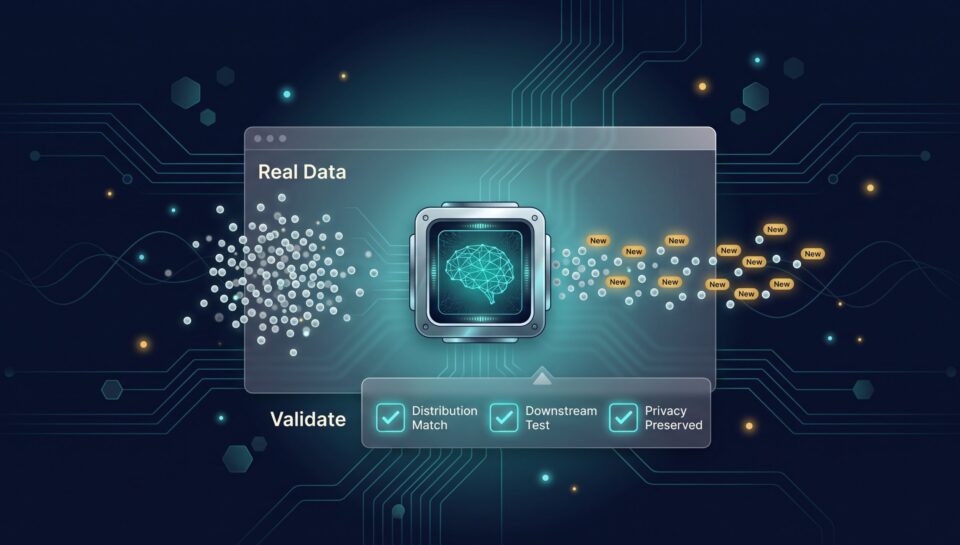
Synthetic data has moved from a niche technique to a mainstream part of how AI teams build datasets. The pitch is compelling: generate the data you need instead of collecting it, sidestep privacy constraints, and produce rare edge cases on demand. The reality is more nuanced. Synthetic data solves some problems very well and others badly, and the difference between a team that benefits from it and one that quietly degrades its model comes down to knowing which is which, and validating the output rather than trusting it. This guide covers when to generate, when to collect, and how to check that synthetic data is actually fit to train on.
What Synthetic Data Actually Is
Synthetic data is data created rather than collected from the real world. It spans a wide range: fully simulated environments that produce labeled images, generative models that produce text or images resembling real examples, statistical methods that produce records matching the distribution of a real dataset, and augmentation that transforms existing examples into new variations. These are not the same thing, and they carry different risks. Simulation gives perfect labels but may not match reality. Model-generated data inherits the biases and blind spots of the model that produced it. Understanding which method is in play matters more than the label "synthetic."
When Synthetic Data Works Well
Rare events and edge cases. The strongest case. Some scenarios are dangerous, expensive, or nearly impossible to capture in the real world: unusual road hazards, equipment failures, rare medical presentations. Generating them is often the only practical way to give a model enough examples to learn from.
Privacy-constrained domains. Where real data carries regulatory weight, synthetic records that preserve statistical properties without mapping to real individuals can unlock work that would otherwise stall. This is a genuine advantage in healthcare and finance, with the caveat that "synthetic" does not automatically mean "compliant" and the generation method has to be sound.
Balancing a skewed dataset. When one class is badly underrepresented, targeted synthetic examples can correct the balance rather than leaving the model to learn from a lopsided sample. This connects directly to controllingbias in machine learning.
Bootstrapping before real data exists. Early in a project, synthetic data can get a model to a working prototype while real collection is still being organised.
When Real Data Is Better
When the goal is to capture reality's messiness. Real data contains the noise, ambiguity, and unpredictability that models need to survive deployment. Synthetic data is generated from assumptions, and a model trained mostly on assumptions performs well on assumptions.
When your advantage is your data. If proprietary real-world data is the thing that differentiates your model, synthetic substitutes dilute the very asset you are building on.
When the domain is poorly understood. Generating good synthetic data requires knowing what realistic looks like. In domains where that understanding is incomplete, generation encodes the gaps.
When the distribution matters precisely. If the model needs to learn the true frequency of events, synthetic data generated to a designer's assumption of that frequency will teach the wrong thing.
The Honest Middle Ground
In practice the useful answer is rarely all synthetic or all real. Most strong datasets blend them: real data as the foundation that anchors the model to reality, synthetic data layered in to fill specific known gaps such as rare cases and underrepresented classes. The blend is a design decision, and it should be deliberate and documented rather than incidental. Our guide tosourcing training data covers the collection side that anchors this.
The Part Teams Skip: Validation
Synthetic data arrives with labels attached, which creates a dangerous illusion of quality. The labels are correct by construction; the question is whether the data itself is representative. That question can only be answered by checking, and validation is where most synthetic data programmes are weakest.
Fidelity. Does the synthetic data actually resemble real data in the ways that matter for the task? Statistical similarity is not enough if the model keys on features the generator got wrong.
Coverage. Does it span the range of conditions the model will encounter, or has the generator produced many variations of a narrow slice?
Bias. Model-generated synthetic data inherits the generating model's biases, and can amplify them. Checking for this is essential, particularly when synthetic data was introduced to correct a bias in the first place.
Leakage and duplication. Generated examples that are near-duplicates of each other add volume without adding information, and can leak between training and evaluation sets.
Downstream performance. The definitive test: does a model trained with the synthetic data perform better on real held-out data? This is the measure that matters, and it requires a real evaluation set regardless of how much of the training data is synthetic.
Validation is human-in-the-loop work. It uses the same measurement discipline asannotation quality assessment: sampling, structured review against clear criteria, and measured agreement between reviewers.
Practical Guidance
Start from the gap, not the technique. Identify what your dataset is missing, then ask whether generating it or collecting it is the better route for that specific gap. Keep a real evaluation set that is never synthetic, since evaluating synthetic-trained models on synthetic data tells you almost nothing. Document what is synthetic, how it was generated, and why, so the dataset stays auditable. And validate before training, not after the model disappoints.
Where a Partner Fits
Teams often generate synthetic data in-house, close to the model. The work that more commonly moves to a partner is the validation and the blend: assessing whether a synthetic dataset is fit for purpose, sampling and reviewing it against real data, checking coverage and bias, and preparing the real data that anchors the mix. That is human review work at volume, with the measurement discipline to make the findings trustworthy.
Common Questions From US AI Teams
What is synthetic data for AI?
Data created rather than collected, spanning simulation, generative models, statistical methods, and augmentation. It is used to fill dataset gaps, especially rare cases and privacy-constrained domains.
Is synthetic data as good as real data?
For some purposes, yes. For capturing the messiness and true distribution of the real world, no. Most strong datasets blend real data as the foundation with synthetic data filling specific known gaps.
When should I use synthetic data?
For rare or dangerous edge cases that are impractical to capture, in privacy-constrained domains, to balance an underrepresented class, and to bootstrap a prototype before real collection is organised.
When should I avoid synthetic data?
When the model needs to learn reality's noise and ambiguity, when proprietary real data is your competitive advantage, when the domain is poorly understood, or when the true frequency of events matters precisely.
How do you validate synthetic data?
By checking fidelity to real data, coverage across conditions, inherited bias, duplication and leakage, and above all whether a model trained on it performs better on a real held-out evaluation set.
Does synthetic data solve privacy problems automatically?
No. Synthetic records can reduce privacy exposure when generated soundly, but "synthetic" does not automatically mean compliant. The generation method determines whether real individuals remain identifiable.
Can synthetic data make bias worse?
Yes. Model-generated synthetic data inherits and can amplify the generating model's biases, which is particularly risky when synthetic data was introduced to correct a bias in the first place.
Should evaluation data ever be synthetic?
No. Keep a real held-out evaluation set regardless of how much training data is synthetic. Evaluating a synthetic-trained model on synthetic data tells you very little about real performance.
Working With Prudent Partners
Prudent Partners Private Limited helps US AI teams validate and blend synthetic data: assessing fidelity, coverage, and bias against real data, preparing the real data that anchors the mix, and running the structured human review that makes the findings trustworthy. For the collection side, see our work ontraining data anddata sourcing, and for the full scope, ourAI data annotation services overview.
The first conversation is a 30-minute scoping call about your dataset, the gaps you are trying to fill, and how you plan to prove the data is working. No commitment to go further.