A model that performed well at launch will not necessarily perform well six months later, and the decline is rarely announced. Nothing errors. No alert fires. The system continues producing confident output while quietly getting worse, and the problem surfaces through customer complaints or a bad decision rather than through monitoring. This is one of the most common and least planned-for realities of running AI in production. This guide covers why models degrade, what to monitor, and where automated monitoring falls short.
Why Models Degrade
The world changes. The relationships a model learned reflect the period its training data covered. Customer behavior shifts, products change, language evolves, and the patterns stop matching. This is data drift, and it is not a defect but a consequence of deploying a static artifact into a moving environment.
The inputs change. An upstream system starts formatting a field differently, a new customer segment arrives, a data source changes. The model receives inputs unlike anything in training and behaves unpredictably.
The knowledge goes stale. For retrieval-based systems, the corpus ages. Documents are superseded but not removed, and the system confidently cites guidance that is no longer current. Freshness is a first-order accuracy problem here rather than a housekeeping issue. Ourretrieval-augmented generation overview covers this architecture.
The model underneath changes. Teams building on third-party models inherit updates they did not choose. Behavior shifts without any change on your side, which makes external dependency a monitoring concern rather than a procurement one.
Feedback loops compound. When model output influences the data it later learns from, small biases amplify over time rather than washing out.
What Monitoring Should Cover
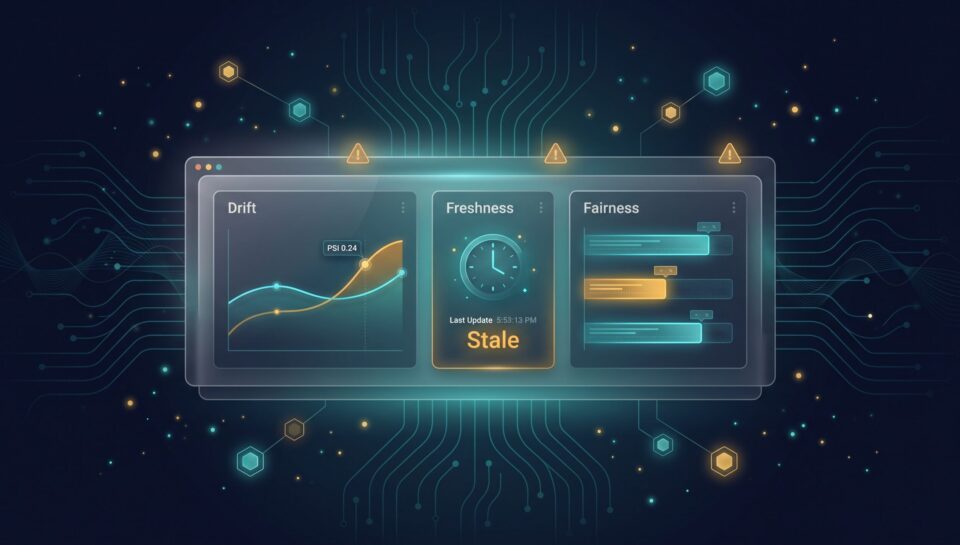
Input distribution. Whether the data arriving now resembles what the model was built for. Shifts here predict quality problems before they show up in outcomes, which makes this the earliest available warning.
Output distribution. Whether the pattern of predictions or generations has changed. A classifier suddenly assigning a class twice as often is a signal, whether or not accuracy has visibly dropped.
Outcome quality. Where ground truth eventually arrives, actual accuracy over time. This is the most meaningful measure and usually the most delayed.
Fairness across groups. Whether performance differs across populations, and whether that gap is widening. Aggregate accuracy routinely conceals divergent performance between groups, which is the failure mode with the highest reputational and regulatory cost. Our guide tobias in machine learning covers the underlying mechanisms.
Freshness. For retrieval systems, the age of the corpus and the proportion of retrieved content that is outdated.
Operational signals. Latency, cost per request, error rates, and for agents, step counts and tool failure rates.
The Limits of Dashboards
Automated monitoring detects what it was configured to detect. That covers statistical shifts and threshold breaches well and misses several important things.
It misses quality problems that do not move the statistics: a generative system whose answers become subtly less useful while remaining well-formed and appropriately distributed. It misses novel failure modes not represented in existing metrics. It misses context, since a distribution shift can be a genuine change in the world requiring no action, or the first sign of a serious problem, and the metric alone does not distinguish them. And it can create false confidence, where green dashboards are read as evidence of quality rather than absence of the specific problems being watched.
Where Human Review Belongs
The practical answer is sampled human review running alongside automated monitoring. People periodically examine real production output against the same criteria used before launch, which catches degradation that statistics do not capture and provides the judgment that turns a signal into a decision.
The value is highest on generative and agentic systems, where output quality is a judgment rather than a measurement, and in regulated or high-stakes domains where a subtle decline has serious consequences. The discipline is the same as any structured review: clear criteria, trained reviewers, measured agreement, as covered in ourannotation quality guide. OurAI quality assurance function covers this in production.
Closing the Loop
Monitoring only has value if findings act on something. That means a defined path from detection to response: sampled failures become evaluation cases so the same problem cannot silently return, recurring failure categories drive retraining or data updates, stale content is removed rather than accumulating, and fairness gaps trigger investigation rather than a note in a report.
Teams frequently build monitoring and never build the response path, which produces detection without correction and, over time, alerts that are watched less carefully each month.
Governance and Inventory
At organisational scale, a prior question arises: which AI systems are actually running, who owns them, what data do they touch, and which are monitored at all. Many organisations cannot answer this, and unmonitored systems tend to be the ones that produce the incident. An inventory with named owners and a stated monitoring level is unglamorous and is usually the highest-return governance step available.
Common Questions From US Teams
Why do AI models degrade after deployment?
Because the world, the inputs, and the underlying models all change while the deployed model stays static. Retrieval corpora also age, and feedback loops can compound small biases over time.
What should be monitored in production AI?
Input and output distributions, outcome quality where ground truth arrives, fairness across groups, corpus freshness for retrieval systems, and operational signals like cost, latency, and tool failure rates.
Why is data freshness an accuracy problem?
Because a retrieval system will confidently cite superseded guidance if outdated documents remain in the corpus. For these architectures, freshness determines correctness rather than merely tidiness.
What do monitoring dashboards miss?
Quality declines that do not move the statistics, novel failure modes outside existing metrics, and the context needed to distinguish a benign distribution shift from an emerging problem.
Why monitor fairness separately from accuracy?
Because aggregate accuracy conceals divergent performance across groups. A model can hold steady overall while degrading substantially for one population, which is the costliest failure to discover late.
How does human review complement automated monitoring?
People sample real production output against pre-launch criteria, catching subtle quality decline that statistics miss and supplying the judgment that turns a signal into a decision.
What should happen when monitoring detects a problem?
Sampled failures should become permanent evaluation cases, recurring categories should drive retraining or data updates, stale content should be removed, and fairness gaps should trigger investigation rather than a note.
What is the most overlooked governance step?
An inventory of which AI systems are running, who owns them, what data they touch, and which are monitored. Unmonitored systems are disproportionately the ones that produce incidents.
Working With Prudent Partners
Prudent Partners Private Limited provides the human review layer for production AI monitoring: sampled assessment of real output against defined criteria, fairness review across populations, corpus freshness review for retrieval systems, and failure findings converted into permanent evaluation cases. See ourAI quality assurance function and our guide tobias in machine learning.
The first conversation is a 30-minute scoping call about your deployed systems, what is currently monitored, and where the blind spots are. No commitment to go further.