Every AI team eventually hits the same wall: the data they need does not exist. Public datasets do not cover the specific conditions, populations, devices, or languages the model has to handle, and the company's own data has gaps that no amount of cleaning will fill. At that point the options narrow to one. The data has to be created, deliberately, to a specification. That is what data collection services do. This guide covers how commissioned collection works, what it involves beyond simply gathering files, and how US teams evaluate a collection partner.
For the broader question of where training data comes from, ourdata sourcing overview covers the landscape. This guide is about the collection route specifically.
When Collection Is the Right Answer
Collection is the expensive option, so it is worth being clear on when it earns the cost. It makes sense when the target conditions are not represented in available data, such as specific environments, lighting, accents, dialects, or device types. It makes sense when the model must work for a population that public datasets underrepresent, which is a common source of biased performance. It makes sense when rights matter and you need data you unambiguously own, which is an increasingly common requirement as the legal landscape around scraped training data tightens. And it makes sense when the task is specific enough that no general dataset will do.
If none of those apply, existing data plus good curation is usually cheaper and faster.
What Commissioned Collection Actually Involves
The word "collection" undersells the work. A serious collection programme has several parts.
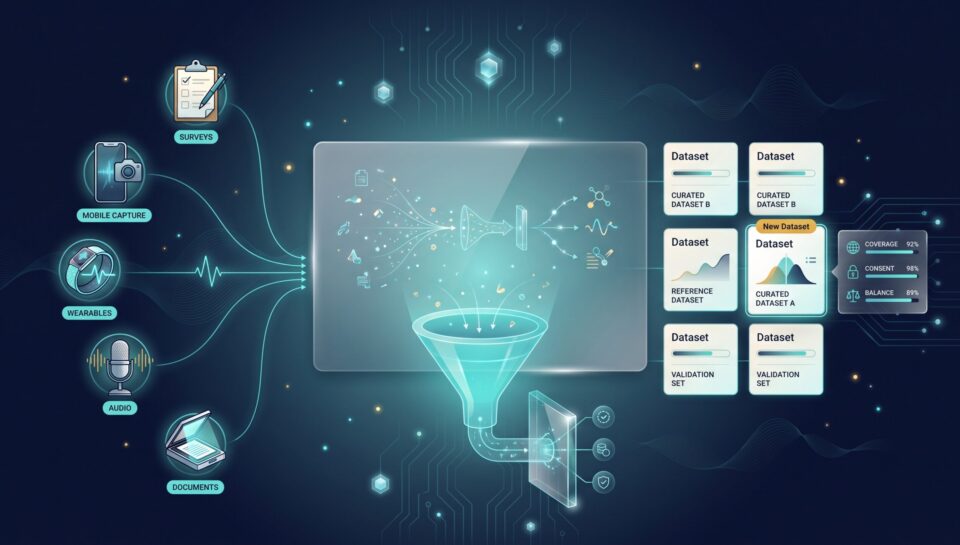
Specification design. Defining precisely what needs to be captured: conditions, quantities, demographics, devices, environments, and the acceptance criteria for a usable item. Vague specifications produce unusable data at volume, which is the most expensive failure mode in this work.
Participant recruitment. For data involving people, whether speech, images, video, or behavior, finding participants who match the required profile. This is operational work: sourcing, screening, scheduling, and managing people at scale.
Consent and rights. Securing informed consent and the rights to use the data for AI training, documented properly. This is not paperwork to be rushed. It determines whether the dataset is legally usable, and retrofitting consent is impossible.
Capture execution. Running the collection itself: field capture, studio capture, device and sensor recording, or remote collection through an application. Each carries its own quality risks.
Quality control at capture. Checking items against the specification as they arrive rather than at the end. Collection that is only validated after completion routinely delivers a large share of unusable items with no route to recover them.
Preparation and labeling. Raw collected data is rarely training-ready. It usually needs cleaning, organising, and annotation before it can be used, which connects collection directly to theannotation quality discipline.
The Part That Goes Wrong
The most common failure in commissioned collection is a specification that seemed clear and was not. A brief that says "500 hours of conversational speech" without specifying accents, recording conditions, speaker demographics, background noise, and turn structure will produce 500 hours of something, and quite possibly 500 hours of the wrong thing. Good collection partners push back on vague specifications and insist on a small pilot batch before scaling, precisely because the cost of discovering a specification problem at volume is severe.
Representativeness and Bias
Collection is one of the few points where a team has direct control over whether a dataset is representative, which makes it a lever on model bias rather than an afterthought. If the collection specification underrepresents a population, the model will underperform for that population, and no downstream technique fully repairs it. Deciding the demographic and condition coverage deliberately, at specification time, is the single highest-leverage choice in a collection programme.
Rights and Compliance
Commissioned collection has a genuine advantage over scraped or licensed data: you know exactly where it came from and what rights attach. Realising that advantage requires the consent and documentation to be handled properly. For collection involving people, expect a partner to be able to explain their consent process, their data handling and storage, and how participant privacy is protected. In regulated domains the requirements are stricter and should be confirmed explicitly rather than assumed.
How to Evaluate a Collection Partner
The questions that matter: can you recruit the specific participant profile we need, and at what scale; how do you handle consent and rights documentation; how do you quality check items during collection rather than after; will you run a paid pilot batch before scaling; how do you handle the coverage and demographic balance of the collection; and can you prepare and annotate the data, or do we need a second partner for that. Ourvendor evaluation guide covers the wider procurement discipline, and ourpricing guide covers comparing cost on a usable-item basis rather than a raw-volume basis.
Cost Reality
Collection costs more per item than any other route to data, and the honest comparison is cost per usable item after quality rejection, not the headline per-item rate. A cheap collection with a high rejection rate is expensive. This is also why the pilot batch matters: it establishes the real yield before the budget is committed.
Common Questions From US AI Teams
What are data collection services for AI?
Services that create datasets to a specification rather than sourcing existing data: specification design, participant recruitment, consent and rights handling, capture execution, quality control, and preparation for training.
When should we commission data collection instead of using existing data?
When the conditions, populations, devices, or languages you need are not represented in available data, when you need data you unambiguously own, or when the task is too specific for any general dataset.
What makes a collection project fail?
Almost always a specification that seemed clear and was not. Without precise conditions, demographics, and acceptance criteria, a collection delivers volume of the wrong thing, discovered too late to recover.
How does collection affect model bias?
Directly. Collection is one of the few points where you control representativeness. If the specification underrepresents a population, the model underperforms for that population, and downstream techniques do not fully repair it.
Who owns data that is collected for us?
That depends on the agreement, but a key advantage of commissioned collection is clear provenance and rights. Confirm ownership and permitted use explicitly, and expect proper consent documentation for anything involving people.
Do we need a pilot batch before a full collection?
Yes. A pilot establishes the real yield and surfaces specification problems before the full budget is committed. Partners who resist a pilot are a warning sign.
Is collected data ready to train on?
Rarely. Raw collected data usually needs cleaning, organising, and annotation before it is training-ready, so plan for that stage or choose a partner who covers both.
How should we compare the cost of collection partners?
On cost per usable item after quality rejection, not the headline per-item rate. A low rate with a high rejection rate is the more expensive option.
Working With Prudent Partners
Prudent Partners Private Limited supports US AI teams with commissioned data collection and the preparation that follows: specification design, participant recruitment, consent and rights documentation, capture execution with in-process quality control, and annotation to make the data training-ready. For the wider picture, see our work ontraining data,AI training datasets, and ourAI data annotation services overview.
The first conversation is a 30-minute scoping call about what you need to capture, the coverage it requires, and the rights position you need. No commitment to go further.